We have all thought “I’m having trouble with my balance (now that I’m getting old)”.
It is a fact of life; what we don’t use withers and dies. Spending days in bed or a wheel chair zaps your stability; you have seen this effect on people you know. When injury or surgery happens to young people they get over it and press on with life, not by accepting assisted living.
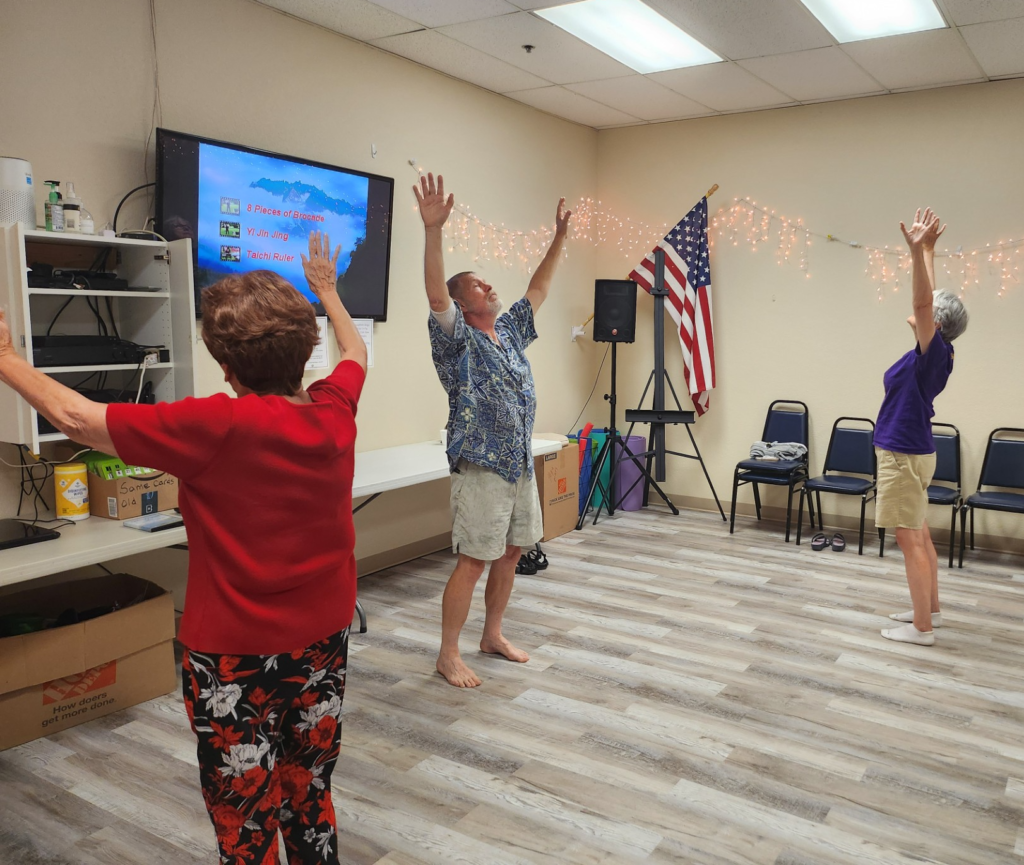
In T’ai Chi we use our balance and extend our balancing abilities. This is why your doctor may have recommended T’ai Chi to you.
Don’t Lose Your Balance!
Did you just fall down? No, then your balance is working, you didn’t lose anything. How to you not lose your balance, the same way you don’t think about a pink elephant.
We are going to change that inner dialog to a positive action
Strengthen your stability!
Here is a list of actions you may take to improve your stability (in no particular order).
- Stand on one foot.
- Grab a solid object and stand on one foot.
- Close your eyes while standing.
- Look left then right then left very quickly. [If you become dizzy consult your physician about possible inner-ear issues.]
- Lift your heals off the ground, stand on the balls of your feet. Step as needed but remain on the balls of your feet.
- Take off your shoes.
- Press all your toes into the carpet, then grab the ground like a bird on a perch.
- Bend your knees.
- Wear minimalist shoes (be aware: if you’ve never worn them it will take months for your body to adapt).
- T’ai Chi practice
- Do the T’ai Chi exercises with your eyes closed.
- Only one foot on the floor while standing in the grocery checkout line.
- Push yourself to the edge and learn to catch yourself (step) when the balance is lost. [This is called walking. Every walk begins with losing your balance forward.]
- Lock your knees when you want to practice losing your balance. Unlock when you step out.
- Work on retaining your stability instead of stepping (stepping is the failsafe action).
- Stand on one leg and flail around; arms and leg, catching yourself without stepping.
- Do all of the above with your hands overhead (elevated center of gravity).
- Bicycle riding requires balance, you could do that as a child and can still do it today if you maintained that skill. If you are unstable on a 2-wheel bike today, most likely it is because your brain has recycled those neurons because they haven been used in decades.
- Ankle and foot mobility movements.
- Leg strength.
- Erect/correct posture. Eye up, not at the ground.
- Good sleeping habits. Sleep deprivation and/or fatigue lessens stability (“stumbled out of bed”).
Bottom line: Intentional focused practice will result in the development of neural pathways and stronger muscles thus fortifying your stability.